A dental bridge is one of the most effective, time-tested ways to replace a missing tooth — restoring your ability to eat, speak, and smile with total confidence. At Macleod Dental, we craft bridges that look and feel completely natural.
A dental bridge quite literally bridges the gap left by a missing tooth. It consists of one or more artificial teeth (called pontics) held in place by dental crowns cemented onto the healthy teeth either side of the gap — the abutment teeth. The result is a fixed, stable, natural-looking restoration that functions exactly like your own teeth.
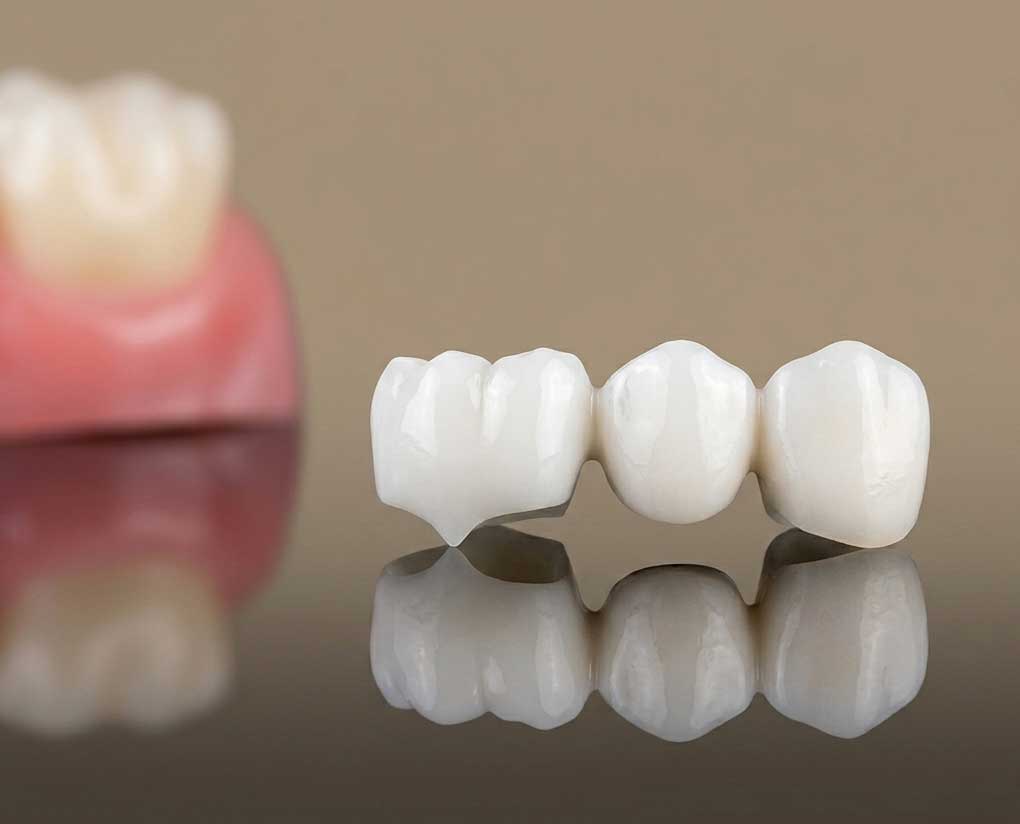
The artificial replacement tooth that fills the gap. Custom-crafted from porcelain to match your surrounding teeth perfectly.
The natural teeth on either side of the gap, prepared and crowned to anchor the bridge firmly in place.
A fixed, permanent restoration that looks, feels, and functions just like your natural teeth — no removal needed.
Is a Bridge Right for You?
Are missing one or more adjacent teeth
A bridge works best when replacing one to three consecutive missing teeth.
Have healthy teeth on either side of the gap
The abutment teeth must be strong enough to support the bridge and withstand normal bite forces.
Have good overall oral health
Healthy gums and no active decay or infection are essential before we place a bridge.
Want a fixed, non-removable solution
Unlike dentures, a bridge is permanently cemented and does not need to be removed for cleaning.
Not sure if a bridge is right for you? We will assess your individual situation and discuss all your options at your consultation — with no pressure and complete transparency.
Why replace a missing tooth at all?
Adjacent teeth drift into the gap over time, affecting your bite
Jawbone begins to resorb without a tooth root to stimulate it
Chewing function is compromised, placing strain on other teeth
Speech can be affected, particularly for front teeth
Confidence and smile aesthetics are impacted
The longer a gap is left untreated, the more complex and costly the solution becomes. Acting early makes a real difference.
A dental bridge is typically completed over two appointments. Here’s exactly what to expect.
Step 01
We examine your teeth, take X-rays, and discuss whether a bridge is the right solution for your situation.
Step 02
The abutment teeth are gently reshaped under local anaesthetic to create space for the bridge crowns.
Step 03
Precise impressions are sent to our dental laboratory. A temporary bridge protects your teeth in the meantime.
Step 04
Your bridge is custom-crafted from high-quality porcelain to precisely match the shade, shape, and size of your natural teeth.
Step 05
We check the fit, colour, and bite carefully before permanently cementing your bridge in place. You leave with a complete smile.
There’s no single “best” solution for a missing tooth — the right choice depends on your situation. Here’s an honest comparison.
| Feature | Dental Bridge | Dental Implant | Partial Denture |
|---|---|---|---|
| Fixed & non-removable | ✓ Yes | ✓ Yes | ✗ No |
| No surgery required | ✓ Yes | ✗ No | ✓ Yes |
| Preserves jawbone | Partial | ✓ Yes | ✗ No |
| Completed in 2 visits | ✓ Yes | ✗ No (months) | ✓ Yes |
| Longevity | 10–15+ years | 20+ years | 5–10 years |
We will help you choose the right option for your health, budget, and lifestyle at your consultation.
Getting a bridge is not painful. We use local anaesthetic during tooth preparation so you will be completely comfortable throughout. You may experience some sensitivity in the days following the procedure, which settles quickly. Most patients find the process significantly more straightforward than they expected.
A dental bridge typically involves two appointments spaced 2–3 weeks apart. The first appointment covers tooth preparation and impressions; the second fits and cements your permanent bridge. The total process from consultation to completion usually takes 3–4 weeks.
With good oral hygiene and regular dental check-ups, a well-maintained dental bridge can last between 10 and 15 years or more. Avoiding habits such as chewing on hard objects or ice will help extend the lifespan of your bridge significantly.
Once you are accustomed to your bridge — usually within a few days — you can eat almost everything you normally would. We recommend avoiding very hard or sticky foods such as toffees, hard lollies, or chewing on bones, as these can place excessive stress on the bridge. Otherwise, you can eat and drink completely normally.
Yes — many private health fund extras policies provide a benefit towards dental bridges under major dental. The amount covered varies depending on your fund and level of cover. We recommend checking with your fund ahead of your consultation, and we are happy to provide a written treatment estimate to submit for a quote before you proceed.
Cleaning under and around a dental bridge requires a slightly different technique. You will need to use floss threaders or interdental brushes to clean beneath the pontic, where normal floss cannot reach. We will show you exactly how to care for your bridge at your fitting appointment so you can keep it in excellent condition long-term.
The gold standard for permanent tooth replacement without involving adjacent teeth.
When a tooth must be removed, we guide you through your best replacement options from the start.
The crowns that anchor each end of a bridge are an integral part of the restoration.
Regular maintenance is essential to keep your bridge and surrounding teeth in excellent condition.
Ready to restore your smile?
Book a consultation at Macleod Dental and we’ll assess whether a bridge is the right solution for you — with honest advice, clear pricing, and no pressure.